Why We are Building a New Ops Dashboard


The ten-minute question
Walk into any recruitment company at 9:30 in the morning and watch what people do first.
- The recruiter opens their email, then the applicant tracking system, a spreadsheet, or both. They pick one of fourteen open jobs — usually the one whose client wrote most recently — and start.
- The team lead does the same, and ends up sending messages: “Where are we on the bank role?” “Did anyone touch the Hyderabad position this week?”
- The manager finds out what happened from the weekly report, five days later.
The tools differ from company to company; the problem does not. Nobody here is lazy or lost. What none of them can answer quickly is:
- Which job should I work on right now?
- How much work on it is enough?
- When should I stop and move to the next one?
Every system they use records what already happened. None of the systems we have evaluated answers these questions, and that is the gap we are building for.
The Google Maps idea
Google Maps changed driving in three ways:
- It always shows the next turn.
- It recalculates the moment anything changes — traffic, a missed exit, a closed road.
- It never takes the wheel. Take a different road, and it draws a new route from there.
We are building the same thing for recruitment work: a board that shows the next job, recalculates as the day changes, and leaves the final call with people.
But a map needs a rule for choosing routes. Maps picks the fastest arrival. The board uses two rules: the first decides priority, the second decides effort.
Priority: which job to work first
Most teams prioritise by whoever shouted last or whatever feels biggest. The biggest job is often the least likely to close.
The board ranks every job by its revenue potential, built from three inputs:
| Input | What it tells the board | Where it comes from |
|---|---|---|
| Chance to convert | How likely this job is to produce a placement | The client’s own conversion history |
| Revenue per hire | What one placement earns | The contract terms with the client and the job’s salary |
| Number of positions | How many placements the job can produce | The job requirement |
Revenue potential = chance to convert × revenue per hire × number of positions
The job with the highest revenue potential is worked first.
Illustrative example
A single ₹30L role at a client who rarely converts can rank below a ₹12L role with three positions at a client who hires reliably. The bigger salary does not make it the better job.
Effort: how much work is enough
Once a job is being worked, the goal is not to source indefinitely. The board sets the optimal amount of work from the client’s past conversions — no more, no less.
Illustrative example
A client hires one person for every five profiles sent and needs two people. The target is about ten profiles.
- Fewer than ten: The client may fill the role elsewhere.
- More than ten: Hours go into a job that is already covered, taken from the next job on the list.
The target tells the recruiter how much work to put in, and when to stop.
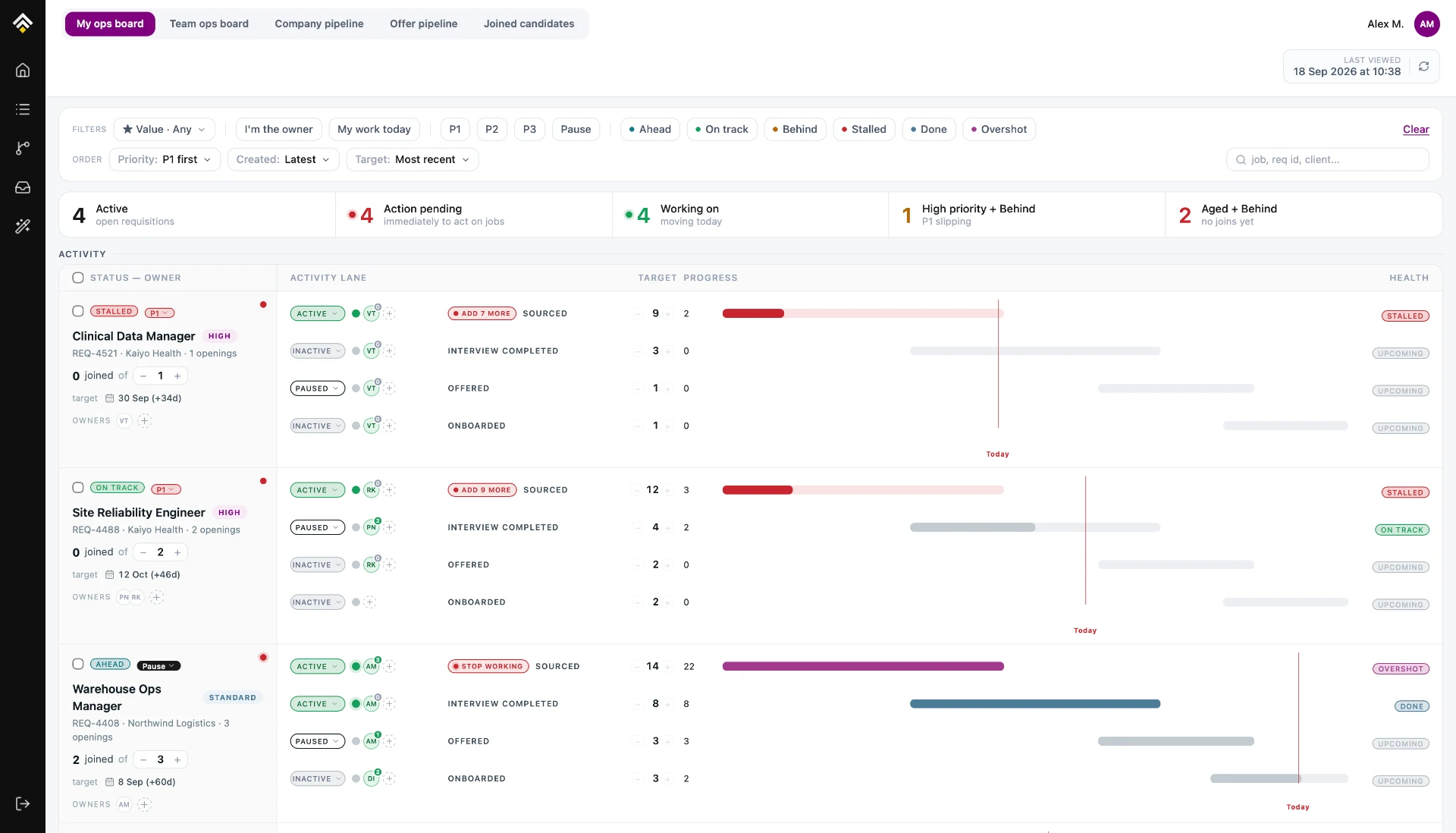
Prototype — actual images may vary.
How the day runs
Priority and effort are recalculated as things happen:
- A new job arrives, or positions are added: It takes its place in the ranking immediately.
- A client speeds up — fast feedback, candidates moving through stages: The job rises and its target opens up.
- A client goes quiet — no responses, profiles sitting unreviewed: The job drops and work pauses until the client responds.
- An offer is accepted with a long joining date: The job is treated as at risk, not done, and some effort continues behind it.
At every point, the recruiter follows one loop:
- Pick: The job with the best return.
- Work: To its target, and no further.
- Move: To the next job on the list.
Then the loop starts again, from a ranking that has already updated.
The board also spreads the work across the team, so the most valuable jobs do not all land on one person, and flags anyone carrying too much.
What the manager controls
The board applies the company’s rules without waiting for instructions. If the manager takes no action today, every recruiter still knows what to work on and when to stop.
But the manager knows what the data cannot: a promise made to a client, a relationship being repaired, a brief that changed on a call. So the manager can override any decision, at any time:
- Raise or lower a job’s priority
- Change a job’s target
- Pause or resume a job
- Move a job to another recruiter, or lend a person for the day
- Change a deadline
Each override is one click. The board re-plans around it for everyone and marks it, so the team can see which calls came from a person rather than the rules. Recruiters can take a different route on their own list in the same way.
What a company gets
- Hours go where they pay: To the jobs with the best return, re-ranked as the day changes.
- Waste is visible in both directions: The job nobody touched and the job worked past its target both show up the day it happens.
- Effort stops when a client goes quiet: Instead of continuing for weeks.
- Managers handle exceptions, not routing: The routine day runs on the company’s own rules.
- The picture is accurate: Built from stage movements, client responses and dates, not status updates.
- No new data entry: The board reads what the team already records.