From Speed to Quality: How AI Is Redefining Recruitment

The Changing Face of Hiring
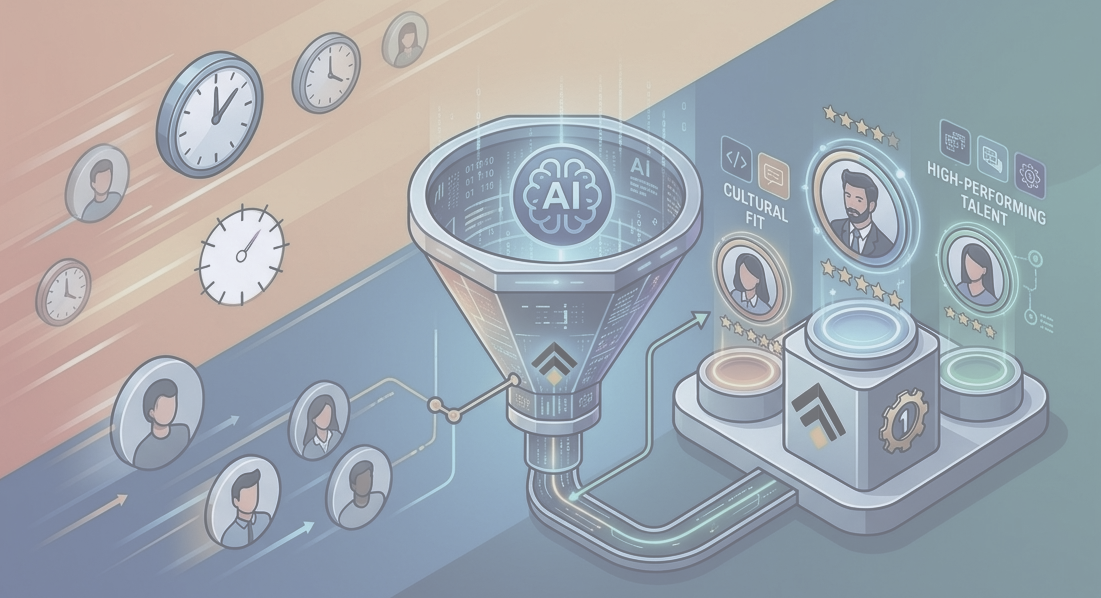
For years, recruiters have been measured on one thing above all else: how quickly they can fill a role. That's changing. Organizations are increasingly turning to AI-driven tools to move past speed alone and focus on hiring that truly fits — hires who stay longer, perform better, and grow with the company.
Filling a role fast isn't the same as filling it right, and more teams are catching on to that distinction. According to a 2025 report by the Economic Times, nearly 75% of Indian recruiters now put up to 70% of their hiring budgets toward AI tools that improve match accuracy and retention. The competition isn't to hire faster anymore — it's to hire better.
Why Speed Alone No Longer Works
Traditional hiring has long leaned on metrics like time-to-hire and cost-per-hire. But these numbers can be deceiving — a quick hire who leaves within six months often ends up costing more than a slower, more deliberate one.
Today's workforce, especially Gen Z professionals, cares about alignment, growth, and purpose. A recruiter chasing speed alone risks missing the things that actually predict success: culture fit, learning orientation, and shared values. Add in how fast new skills and roles are emerging — often faster than education systems can keep up — and it becomes clear that quality hiring is the only strategy built to last.
The AI Advantage: Beyond Resume Screening
AI in recruitment has moved well past keyword scanning and basic chatbots — it's now about genuinely intelligent decision-making. Here's where that shows up in practice:
Predictive matching. AI models analyze historical hiring outcomes — who succeeded, who didn't, and why — to forecast future fit, weighing behavioral patterns and adaptability alongside skills.
Bias-aware screening. Algorithms can flag potential bias creeping into job descriptions, scoring criteria, or interviewer feedback, helping keep shortlists more inclusive.
Conversational engagement. Recruiters lose up to 40% of qualified candidates simply due to poor follow-up. Generative-AI-powered engagement tools keep communication warm and personalized without adding to a recruiter's workload.
Real-time insights. Dashboards now surface live answers to questions like "which sourcing channels produce high-retention hires" or "which interviewers' shortlists convert into successful placements" — letting teams adjust strategy as they go, not after the fact.
A Shift in KPIs: Measuring What Really Matters
As the focus moves from quantity to quality, the metrics recruiters track are shifting too:
| Traditional Metrics | Emerging Quality Metrics |
|---|---|
| Time-to-Hire | Quality-of-Hire |
| Number of Hires | Retention After 12 Months |
| Cost-per-Hire | Candidate Experience Scores |
| Offer Acceptance Rate | Performance of New Hires |
Quality-of-hire — tracked through performance, retention, and peer feedback — is becoming the north-star metric for modern talent acquisition teams. AI is what makes it measurable: by connecting post-hire performance data back to pre-hire assessments, recruitment leaders can finally close the loop between who they hired and how that hire actually performed.
Real-World Impact
Tech startups in fast-growing hubs are using AI to spot culture-fit candidates earlier, with some reporting attrition reductions of up to 30%.
Large enterprises are mining historical attrition data to predict which hires are likely to stay, sharpening both recruitment and broader workforce planning.
SMBs and regional firms are finding that quality now beats quantity for them too — affordable AI-as-a-service tools are putting predictive hiring capabilities once reserved for large corporations within reach.
Where Recruiters Still Matter Most
AI can rank, predict, and automate — but it can't replace human intuition, empathy, or storytelling. A recruiter's ability to see beyond the algorithm — to spot potential, passion, and purpose that a score can't capture — remains irreplaceable.
The recruiter's role is evolving into that of an AI-augmented talent strategist, not a gatekeeper: someone who interprets AI's recommendations, questions its anomalies, and builds the trust that ultimately closes a hire. AI supplies the data. People still make the call.
How to Begin the Shift from Speed to Quality
- Define what "quality" means for your organization — retention, performance, innovation, or some mix of the three.
- Start small with the right tools — AI-based resume matching, candidate scoring, or engagement bots are a natural first step.
- Train recruiters to interpret AI output, not just consume it at face value.
- Measure and iterate on long-term outcomes, not just hiring velocity.
- Keep it human. Automation should amplify a good process — not paper over a broken one.
The Road Ahead
Recruitment is at a genuine crossroads. Teams that keep chasing speed alone will stay stuck in the same hiring cycles; teams that embrace AI-driven quality will build stronger, more adaptable workforces. In the years ahead, the most successful recruiters won't be the fastest — they'll be the ones who hire for impact.
At Hirewand, that's the future we're building toward: an AI-native operating system for recruitment where AI empowers human judgment instead of replacing it — bringing sourcing, screening, interviews, and offers together in one place, rather than scattered across disconnected tools.