How Custom Workflows Make Recruitment Automation More Effective

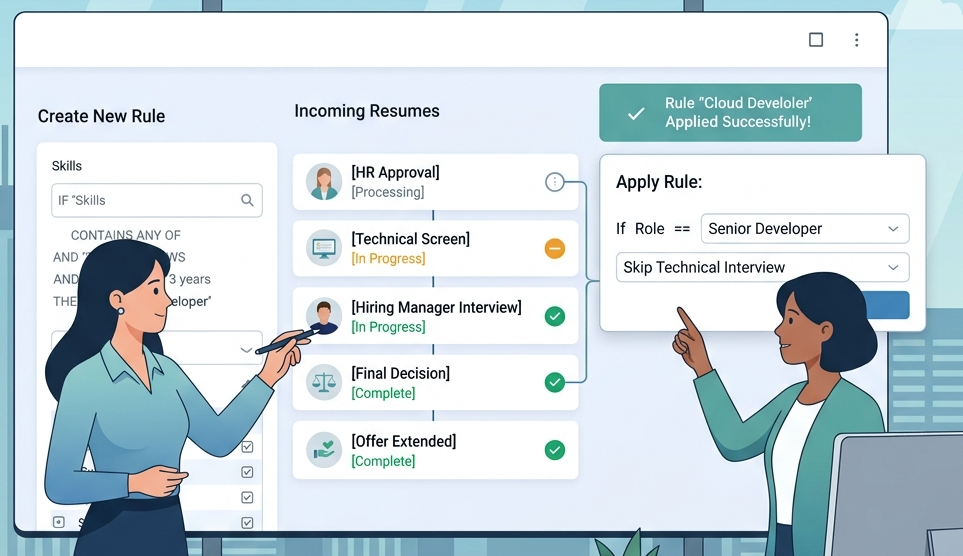
Recruitment software is supposed to streamline hiring, but when it lacks flexibility, it often creates more problems than it solves. Many platforms offer a fixed workflow model, assuming every company hires the same way.
In reality, every organization has its own way of hiring — from approval structures to interview stages to decision-making processes. That's why recruitment automation needs to be customizable to be truly effective.
The downsides of rigid hiring systems
When recruitment software lacks flexibility, companies face serious limitations:
- Limited workflow options. If your hiring process doesn't fit the software's default structure, you're forced to change the way you hire.
- Manual workarounds. Recruiters end up handling approvals, tracking candidates, and following up manually when software can't handle their exact process.
- Bottlenecks in hiring. A rigid system creates delays, leading to longer time-to-hire and missed opportunities.
The power of custom workflows in recruitment automation
With custom workflows and customizable recruitment automation, hiring teams get efficiency without losing flexibility. Hirewand makes this possible by:
- Supporting complex hiring structures. From multiple approval layers to industry-specific hiring flows, the system adapts to your process.
- Automating without rigidity. Zero-click automation for both routine and unique tasks, with recruiters maintaining full control and the ability to intervene when necessary.
- Reducing delays. By ensuring the system moves hiring forward without unnecessary manual intervention, hiring speeds up.
Where customization drives real impact (beyond the basics)
The difference between a good automation tool and a great one is how granular its customization goes. A truly powerful platform doesn't just let you add or remove stages; it allows for tailored logic and 'smart' conditional actions.
1. Context-specific screening and assessments
A one-size-fits-all approach to screening often leads to hiring managers reviewing too many unqualified candidates. Custom workflows let you define screening criteria based on the specific job description, seniority level, or department.
- Rigid: The platform uses the same screening rules for an entry-level SDR as it does for a Senior Architect.
- Custom: The workflow automatically assigns specific assessments (technical tests, case studies) based on the JD. An entry-level role might prioritize soft skills, while a technical role triggers an immediate coding assessment, bypassing initial phone screens.
2. Intelligent approval chains (the bottleneck breaker)
Nothing kills hiring momentum faster than an outdated, linear approval chain. In many systems, an offer rests with an absent manager, halting the process.
A custom workflow with conditional logic (which Hirewand powers with ease) ensures approvals are intelligent. If a compensation package exceeds a set threshold, it automatically routes for additional CFO approval, without the recruiter needing to manually manage the exception. This maintains speed without sacrificing compliance.
3. Department-led communication flows
Candidates for engineering roles interact differently than candidates for sales roles. Their communication preferences (e.g., preference for Slack vs. email), interview formats, and feedback loops are unique. Custom workflows allow each department to define their communication templates and interaction frequency, ensuring every candidate feels a personalized connection to the team they hope to join, not a generic HR bot.
The best recruitment software isn't just automated — it's adaptable
When you choose a flexible platform like Hirewand, you aren't forcing your unique culture and processes into a rigid software box. You are building a system that respects your team's workflow and leverages zero-click automation to scale your hiring success.
Let's build a hiring process that actually works for you.